LEGACY, LEADERSHIP
AND WHAT COMES NEXT

HV MFG recently sat down with Rachael to talk about Fair-Rite’s evolution, her path from engineer to president, the lessons she learned both inside and outside the family business, and how she is leading the company into its next chapter.
HV Mfg: Thanks for agreeing to talk with us. Let’s start with Fair-Rite today. For someone who isn’t familiar, what does Fair-Rite manufacture, and where might they encounter your products?
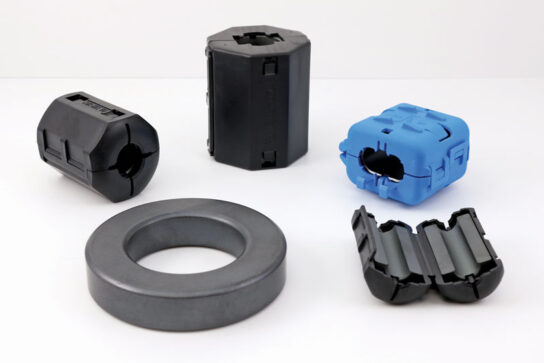
Rachael Parker: We manufacture ferrite components. Ferrite is a ceramic magnetic material, and our products are used primarily in three areas: electromagnetic interference (EMI) suppression, power transformation, and inductive or small-signal applications.
If you have ever seen one of those little bumps on a cable, there’s a good chance that’s a ferrite core helping suppress electromagnetic interference. Our Snap-It’s are probably one of the products people recognize most easily.
HV Mfg: Yes, I’m familiar with the Snap-It’s on laptop chargers and AV cords. What other types of products use ferrite components?
RP: Ferrites are used throughout electronics, automotive applications, communications, power supplies, and a growing number of advanced technologies.
HV Mfg: Considering how much of the world is reliant on advanced technology, including AI, have you seen changes in your business or products?
RP: Absolutely. That’s one of the things that’s exciting about the business right now.
We’re seeing interest around higher-frequency power applications. Think about data centers and the amount of power they require. There is a huge push toward greater efficiency, higher frequencies, and smaller components. Those changes create opportunities for ferrite materials and for us.
We’re also seeing demand from military and defense applications, including products that need to be produced domestically because of ITAR requirements. We’re looking at how we can continue to add capacity here in the United States to support that.
HV Mfg: Tell me a little about your vision for innovation and how you’re working to stay competitive as the industry and demand change?.
RP: Innovation is something we are extremely proud of. For almost 25 years, we went without a patent, and now we’ve had several in just the last few years. We’re proud not only of the work that goes into those patents, but of the innovative mindset behind it.
That mindset has helped us introduce new products like our Clip-It and an oval-shaped snap component, while continuing to explore new materials, geometries, and manufacturing methods.
That’s one of the best things about this work: thinking, problem-solving, and always looking toward what’s next.
HV Mfg: Fair-Rite was founded by your father in 1952. What do you know about how the company began?
RP: My dad was 26 when he started Fair-Rite.
After high school, he went to Cornell for engineering but left voluntarily to serve in the Navy. He wanted to be a Navy pilot, but because of his eyesight, that wasn’t going to happen. During World War II, he became involved in electronics. After the war, he went back to Cornell. The funny thing is that he ultimately graduated with a degree in English literature. So here is this person who would eventually start a ferrite manufacturing company, and he had an English literature degree.
HV Mfg: That’s ironic. How did he make the transition from English literature to ferrite components?
RP: After college, he started selling ferrites. Eventually, with a partner, they decided to start their own ferrite business and named it Fair-Rite, pun intended. They found this location in the hamlet of Wallkill, New York, near the railroad, and that’s how we ended up in the Hudson Valley.
HV Mfg: We understand that you have multiple locations. Briefly tell us about the growth and logic.
RP: Yes, we grew over time. In the 1960s we opened the operation in Illinois, and in 1992 formed a sales branch in Singapore. Later, we established operations in China through a joint venture and eventually through our own entity.
Today, we have roughly 115 to 120 employees in the United States between Wallkill and Flat Rock, Illinois, and a similar number in China.
HV Mfg: You literally grew up around this business. Was it always assumed you would eventually work here?
RP: I wouldn’t say it was expected, but there was always a hope that I would end up at Fair-Rite. I was the “last chance” as the baby in the family, and as I started progressing through my education, my mom recognized the potential for me to eventually run the company. I think I felt that too for a while, but I was also encouraged to find my own path.
HV Mfg: But you still had to figure out what that path looked like. How did you end up in engineering?
RP: I originally thought I wanted to do biomedical engineering when I started at Boston University. Later transferred to the University of Rochester, and I remember taking a Signals and Systems course and thinking, this is it. It just clicked for me. I loved it.
After Rochester, I went to Cornell for my master’s in engineering.
HV Mfg: At that point, joining Fair-Rite would have been the obvious next step. But you made a conscious decision not to do that. Why?
RP: I struggled with that decision. Part of me thought, why not? But I also knew I needed outside experience. I needed to know if I could succeed on my own.
I ended up getting what I considered my dream job at 3M as a development engineer. I worked in digital signal processing and new product development, became a Design for Six Sigma Black Belt and eventually moved into project management and new product introduction.
3M taught me so much about innovation. They were about experimenting and allowing people to explore ideas; it was embedded in how people worked.
I later worked in a very different environment that reinforced how important it is to me to create a place where people collaborate, experiment, and bring ideas forward.

Coming Back to Fair-Rite
HV Mfg: So, what ultimately brought you home?
RP: I came back to Fair-Rite in June 2014. I started in marketing, which, if you know me, was probably not the most natural fit. Eventually, I became vice president, and then in January 2022 I became president.
There was also something very personal about that period. I moved back home temporarily in my 30s, which wasn’t necessarily where I imagined I would be at that point in my life. But looking back, I’m incredibly grateful that I got to work alongside my dad
and then sit around the kitchen table with both of my parents and experience the business through their eyes.
My dad passed away in June 2016. Having those two years with him after I came home means a lot to me. I wouldn’t trade that time.
HV Mfg: Your father’s legacy is quite remarkable; I understand your mother also played a significant leadership role at Fair-Rite.
RP: Yes, my mom became president in 1995, though she had already been involved with the company for a long time. I came back to Fair Rite under her leadership.
HV Mfg: We talk to a lot of companies with father-son succession planning. I would imagine it might be different as mother-daughter.
RP: Every business relationship is different. Working with family is complicated, and being the daughter of the president is complicated, but for me, it was about balance and timing. There were moments when I thought I was ready for more responsibility before she thought I was ready for it. But I see it differently now. There is a tremendous responsibility involved in handing over something that your family has built and that so many other families depend on.
It was important that it happened over time. I needed to understand the business, but I also needed people here to know me as a leader, not simply as the founder’s daughter.
HV Mfg: When did you start to feel that you were actually shaping the organization rather than simply learning it?
RP: In 2020, one of our kilns went down, and I didn’t know about it. That’s a pretty significant thing in our operation, and I remember thinking, ‘how do I not know this?’
So, I started holding meetings twice a week with our department heads.
At first, it was really about communication. What is happening? Where are the issues? What does everyone need to know? But people saw the value in it. The meetings continued because the departments valued understanding what was happening in other areas. Problems surfaced earlier, and people were better prepared to help each other.
That became part of how I think about leadership.
Communication matters, and I want people to feel comfortable raising issues and asking questions.
We have people here who know far more than I do about their areas of the business, and it’s my job to ask the right questions, make sure information is moving, and create an environment where people are comfortable speaking up.
HV Mfg: That requires a certain amount of humility from a leader.
RP: My superpower is that I ask a lot of questions. During my Black Belt training, I learned “Be the village idiot.” We have people here who know far more than I do about their areas of the business, and it’s my job to ask the right questions, make sure information is moving, and create an environment where people are comfortable speaking up.
A Competitive Advantage
HV Mfg: You talk about Fair-Rite as being very family-oriented. How do you maintain that as the company grows and changes?
RP: It really is important to me.
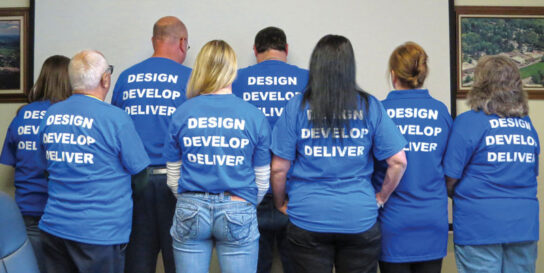
When we say family business, we don’t mean only my family. There are people here who have spent decades of their lives at Fair-Rite. There are generations of families who have worked here.
People need to know that they matter. That doesn’t mean you don’t have expectations or difficult conversations. You absolutely do. But you can hold people accountable and still ensure they feel seen and valued.
It’s not a slogan, or a poster, it’s how people are treated every day. I learned that from my mom.

A Leadership Test Arrives at 3 A.M.
HV Mfg: You became president in January 2022. And then, almost immediately, you faced a potential crisis.
RP: About a month after I became president, one of my colleagues gifted me a bottle of wine and a note that said, “Congratulations on one month as president,” and that night we experienced a cyberattack.
In that moment, you realize very quickly that there isn’t a manual sitting on your desk telling you exactly what to do next. We had to respond, protect the company, and communicate. And, we had to keep moving.
Everyone pulled together and afterward, people told me that the way I handled the cyberattack really cemented my leadership in their minds.
That meant a lot to me. Especially in a family business, a title doesn’t automatically mean that people see you as their leader.
That must be earned in difficult moments.
HV Mfg: You mentioned the growing demand, particularly
from data centers, AI, and defense. How are you planning to capitalize on those opportunities?
RP: Currently, our challenge isn’t finding opportunities. It’s making sure we have the capacity and technology to pursue it, so we must continue investing in equipment, processes, and people.
HV Mfg: What advantages do you see Fair-Rite having to meet these opportunities?
RP: One advantage is the capabilities we have here in Wallkill, New York. For example, our machine shop has been instrumental. Being able to develop tooling and experiment with different approaches helps us innovate and retain industry knowledge and technology here in the United States.
HV Mfg: How does having operations in China fit into that strategy, especially with tariffs and all the uncertainty manufacturers have been navigating?
RP: China has been an important part of our strategy and our ability to remain competitive, but it’s complicated. The environment continues to change, particularly with tariffs, customer requirements, and the increasing importance of domestic manufacturing.
Some things are less expensive to manufacture in China, but we want to keep the knowledge and technology here. That’s particularly important as we look at new opportunities in markets like defense.
We’re constantly evaluating where to manufacture, how to move products, and how we serve customers. Establishing the Foreign Trade Zone at our Flat Rock facility is one example of how we’re responding.
Technology changes. Markets change. Customers change. Something happens geopolitically, or a new application emerges that nobody was talking about two years earlier. I think it’s about having a direction and then building an organization that is resilient enough to adjust how you get there.
Leading Without Pretending to Know the Future
HV Mfg: When you think about Fair-Rite five years from now, can you picture what the company looks like?
RP: I know the direction we’re going, but I don’t pretend that I know exactly what everything will look like five years from now.
Things change too quickly.
Technology changes. Markets change. Customers change. Something happens geopolitically, or a new application emerges that nobody was talking about two years earlier.
I think it’s about having a direction and then building an organization that is resilient enough to adjust how you get there. We have a tremendous team. You need good people, you need to communicate and be curious, and you need to be willing to change course when the information tells you to.
HV Mfg: You’ve talked about things you learned from places like 3M, but your first examples of leadership were your parents. What do you think you carry forward from each of them?
RP: They were very different.
My dad taught me a lot about humility and perseverance. If I came home with a good grade, he would say, “Don’t let it go to your head.” He was incredibly smart and entrepreneurial, but he also believed that you figure things out, pick yourself up, and keep going.
When I was seven, we went to Thailand. My brother and sister were adopted from Thailand, and we had gone back there as a family. There was a little elephant, and my dad said, “Let’s go visit the elephant.” At some point, the elephant picked me up and knocked me over. I was terrified and looking for comfort, but my dad made me go back and pet the elephant again. There is a picture of me bawling my eyes out while I’m petting this elephant because he was basically saying, “You’re not going to be afraid of it. You’re going to go back.”
That was very much my dad. You don’t let the thing that scares you stop you from trying again.
My mom is also a force to be reckoned with, but she taught me empathy, the importance of family, and understanding people’s perspectives. I carry that with me when considering the Fair-Rite team and culture. Fundamentally, that comes from how she integrated our family and the business.
HV Mfg: Your father started Fair-Rite when he was 26 years old. What do you think he would make of the company today?
RP: I know he would be proud, especially of our patents and the forward-thinking behind them. But he’d also tell us not to let it get to our heads.
And then he’d ask what we’re doing next.
Listen to this story on YouTube