Achieving Growth
in Uncertain Times
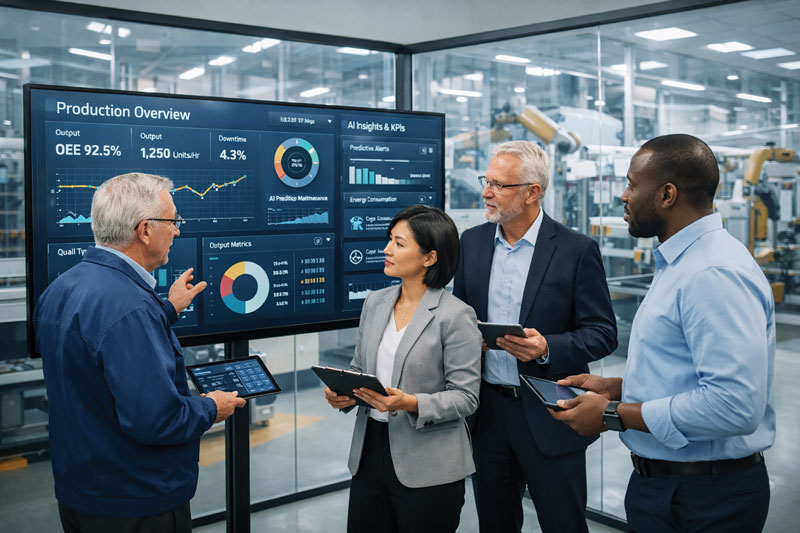
Growth in 2026 isn’t about outrunning the storm; it’s about building an ecosystem where marketing stabilizes the exterior and governance strengthens the core.
Manufacturers today operate in what business leaders call a VUCA world, one defined by volatility, uncertainty, complexity, and ambiguity. It is not just a management term. It reflects the day-to-day reality of industrial operations where market conditions shift overnight, technology cycles shorten, and customer expectations evolve faster than production lead times.
From trade policy shifts and reshoring incentives to election-year volatility, political uncertainty continues to influence business strategy. Meanwhile, technological disruption, from AI and automation to advanced materials and digital platforms, is rewriting traditional value chains faster than most firms can adapt. Many industrial leaders are asking a similar question: How do we sustain growth in the face of so much change?
Across the Hudson Valley & beyond, manufacturers are navigating this turbulence by returning to fundamentals. They are building trust, communicating clearly, and reinforcing operational reliability. Drawing on decades of research and industry experience, Dr. Barry Silverman and Dr. Ibrahim Shaikh emphasize that successful firms in uncertain times treat marketing and innovation governance as twin strategic levers of growth anchored in evidence rather than intuition. As Dr. Silverman notes, “When markets are unsettled, consistency becomes a competitive advantage. Marketing and communication are no longer just about awareness. They are about stability.”
Amid these forces, it is not enough to cut costs or wait for conditions to settle. The firms that thrive govern their growth with discipline by aligning strategy, marketing, and innovation into one resilient ecosystem.
STRATEGIC LEVERS FOR GROWTH
Marketing as a Stabilizing Force
In uncertain times, effective marketing becomes a stabilizing force for customers and employees alike. It’s what keeps relationships intact when budgets tighten and competition intensifies. As Dr. Silverman’s research and consulting work demonstrate, manufacturers that focus on clarity, credibility, and consistency in their messaging position themselves as reliable partners—an attribute customers value even more during disruption.
Industry Examples
Caterpillar, for example, has used its ‘Let’s Do the Work’ campaign to reinforce its image as a partner in productivity rather than just an equipment supplier. By spotlighting the people and industries it serves—from construction crews to farmers—Caterpillar’s storytelling strategy builds emotional connection and long-term trust in a market often driven by short-term price pressures.
Siemens’ ‘Ingenuity for Life’ initiative translates complex technology into human-centered narratives about energy reliability, digital manufacturing, and sustainability. These stories tie operational performance metrics directly to customer value, demonstrating how stability and clarity in communication strengthen market confidence.
The most forward-thinking manufacturers are also using data-driven insights—from CRM systems, market analytics, and digital engagement—to anticipate shifts in demand and adapt early. Firms like Rockwell Automation reinforce this trend through initiatives such as “Expanding Human Possibility,” highlighting how digital platforms and data insights can help manufacturers anticipate operational needs and deliver greater value to customers.
Turning Insight into Action
In short, as Dr. Silverman argues, marketing under uncertainty isn’t about selling harder—it’s about building trust. In a VUCA environment, marketing becomes the connective tissue that binds relationships and sustains confidence.
Manufacturers can strengthen relationships by leveraging their unique assets, from proprietary processes to trusted partnerships, that directly create value for customers. Strategic storytelling helps translate these technical capabilities into clear growth narratives, showing how a company’s expertise, innovation, and reliability solve real-world problems.
Equally important is the use of data-driven marketing to better understand and anticipate customer needs. By analyzing market trends, website analytics, and CRM data, manufacturers can uncover new opportunities, enhance lead generation, and even shape future product development.
The Power of Consistency
Finally, consistency remains the cornerstone of trust. Companies that communicate regularly and transparently across digital channels, trade events, and internal teams establish a sense of stability and longevity that customers value in turbulent times. This lesson resonates strongly with manufacturers across the Hudson Valley’s diverse industrial base.
Innovation Governance as a Resilience Builder
While marketing anchors external relationships, innovation governance strengthens the organization from within by addressing internal resource constraints and political uncertainties. Dr. Ibrahim Shaikh’s research on open innovation governance shows that companies capable of balancing internal capacity with external collaboration outperform peers in volatile environments. For smaller manufacturers, governance does not require a large research organization. It simply means having a disciplined process for deciding which new technologies, partnerships, or product ideas are worth pursuing and which are not.
Over the past two decades, many U.S. manufacturers outsourced portions of their in-house R&D to control costs and focus on short-term performance gains. That improved efficiency but weakened internal innovation capacity to adapt when external disruptions hit.
Today, the conversation is changing. Forward-looking firms are rebuilding strategic capacity—reinvesting in their people, technical infrastructure, and manufacturing depth. They’re realizing that long-term competitiveness depends on balancing openness with strategic ecosystem controls that leverage global partnerships without outsourcing the core capabilities that define their competitive advantage.
Industry Examples
Schneider Electric offers a strong example of this balance. Through its ‘Innovation at the Edge’ program, Schneider connects internal R&D teams with external startups, partners, and universities. These relationships are governed through clear frameworks that keep intellectual property, safety, and strategy anchored inside the company while enabling faster experimentation on the outside.
Bosch demonstrates a similar principle through its ‘Open Bosch’ venture-client model. This initiative allows Bosch’s business units to collaborate with startups under a structured governance system, ensuring that new technologies are validated and integrated without compromising quality or control. Bosch’s Open Source Program Office (OSPO) further institutionalizes this discipline—managing open-source engagement across divisions and ensuring that innovation remains both open and secure.
Likewise, Hyundai Motor Group blends internal capability-building with open ecosystem orchestration. Its ‘ZER01NE Accelerator’ and ‘CRADLE’ global innovation hubs connect external startups with internal business units for co-development projects. Hyundai uses clear proof-of-concept and governance stages to decide which projects scale into production—maintaining agility without losing coherence.
Rolls-Royce provides a complementary case of innovation governance through its ‘IntelligentEngine’ strategy, which integrates AI, data, and digital twins directly into the design and servicing of engines. By aligning digital analytics with traditional engineering depth, Rolls-Royce has strengthened both capability and capacity, ensuring that technological openness feeds long-term resilience rather than eroding it.
THE HUDSON VALLEY OPPORTUNITY
From Manufacturing Backbone to “Quantum Valley”
Nowhere is this transformation more relevant than in the Hudson Valley. What was once a corridor defined by mainframe computing and electronics manufacturing is increasingly being described as the nation’s emerging “Quantum Valley” now positioning itself at the intersection of artificial intelligence, quantum computing, and next-generation industry.
A major catalyst is IBM’s growing quantum computing presence in Poughkeepsie. The company has expanded its quantum data center, which now operates one of the world’s largest concentrations of utility scale quantum computers and serves researchers and companies around the world through the cloud. IBM has also announced plans to develop the world’s first large scale fault tolerant quantum computer, a system expected to perform tens of millions of quantum operations and unlock new possibilities for solving complex industrial problems.
For regional manufacturers, the opportunity extends well beyond quantum computing itself. Large technology platforms rely on extensive supply chains to design, build, and maintain the systems that power advanced computing. Precision machining firms produce specialized components. Electronics manufacturers supply control systems and circuit assemblies. Industrial manufacturers build cooling systems, power infrastructure, and advanced materials needed for high performance computing environments.
As AI and quantum data centers expand, the companies developing these technologies will increasingly depend on suppliers across the broader manufacturing ecosystem. For Hudson Valley manufacturers with expertise in advanced materials, precision fabrication, electronics, and industrial systems, the growth of this technology cluster represents a new set of opportunities to participate in the next generation of industrial innovation.
These developments also illustrate the importance of innovation ecosystems in uncertain times. New technologies rarely emerge from a single company or laboratory. They grow through networks of manufacturers, research institutions, technology firms, and skilled workers that together create the capabilities needed for the next era of industry. In this sense, the Hudson Valley’s emerging “Quantum Valley” reflects the same principle discussed throughout this article: growth in uncertain times comes from building strong capabilities and participating in collaborative innovation networks.
THE PATH FORWARD
Growth in uncertain times requires more than endurance; it requires ecosystem alignment. Marketing provides the voice of stability. Innovation governance provides the backbone of capability. Together, as Dr. Silverman and Dr. Shaikh note, these disciplines form an ecosystem that helps manufacturers move confidently through change.
As the Hudson Valley steps forward as a hub for quantum and AI-driven manufacturing, its firms have the chance to lead nationally—not by avoiding uncertainty, but by managing it better than anyone else.
Those who align brand strength with governance discipline will not only weather turbulence but help define the future of American industry.
Research Note
This article draws on the complementary research programs of Dr. Barry Silverman and Dr. Ibrahim Shaikh at Marist University. Dr. Silverman’s work on brand resilience and generative AI explores how storytelling, credibility, and data-driven marketing build stability in volatile environments. Dr. Silverman’s applied research on brand strategy and consumer behavior, presented through the American Marketing Association and in his dissertation, complements this framework by highlighting how cultural and technological shifts reshape brand trust and market performance. Also, Dr. Shaikh’s research on open innovation governance examines how firms can balance external collaboration with internal capacity to foster technological resilience. Together, their scholarship and consulting experience provide a practical framework for governing growth and marketing strategy under conditions of uncertainty. Key supporting publications include Shaikh & Randhawa (2022a, Technovation), Shaikh & Randhawa (2022b, Industrial and Corporate Change), and Shaikh & Bogers (2025, Digital Policy, Regulation and Governance), which elaborate on open innovation governance, ecosystem orchestration, and capacity–capability alignment.
This article was developed collaboratively by the authors with ethical use of AI-assisted editing tools.

Dr. Barry Silverman is the Schlobach Distinguished Chair in Business at Marist University.

Dr. Ibrahim A. Shaikh is an Associate Professor of Management at Marist University.