Capitalizing on Change
MID-Hudson Manufacturers Navigate Global Uncertainty

The industrial landscape is being defined by what economists are calling the “Great Rebalancing,” as we navigate the first half of 2026. After half a decade of unprecedented supply chain volatility, shifting trade blocs, inflation and interest rate shock, along with a radical restructuring of global trade norms, the manufacturing sector has entered a new era – one where uncertainty is no longer a temporary hurdle to be cleared, but a permanent feature of the terrain.
This transition is felt most acutely by Hudson Valley capital equipment manufacturers, which are the companies that build the machines that build the world. Because their products represent significant, long-term investments for their clients, their order books serve as the most reliable “early warning system” for the broader economy.
When a company buys a multi-million-dollar piece of equipment, they are doing more than upgrading a factory; they are signaling a belief in future demand.
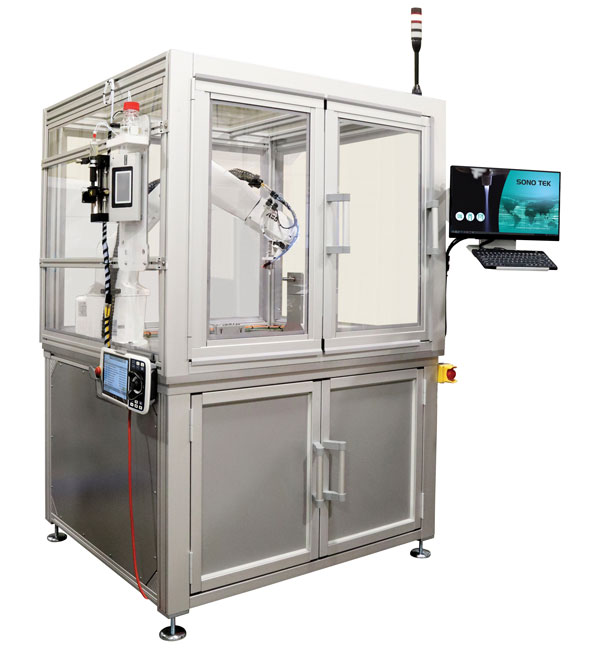
In February, the Council of Industry convened a roundtable with the leaders of five Hudson Valley capital equipment manufacturers. Their insights provide a roadmap for understanding how regional innovation is intersecting with the global economy.
THE CAPEX CONFIDENCE METRIC:
A GLOBAL COOLING?
Capital equipment investment is the heartbeat of industrial health. Historically, high investment levels precede periods of expansion, while a pullback suggests that manufacturers are “turtling,” or protecting their cash reserves and waiting for a more favorable climate.
Right now, that climate is mixed. While the U.S. economy has avoided a “hard landing,” the global picture is one of fragmentation.
In Hawthorne, Westchester County, Oliver Stauffer, CEO of Packaging Technologies & Inspection (PTI), has witnessed this hesitation firsthand.
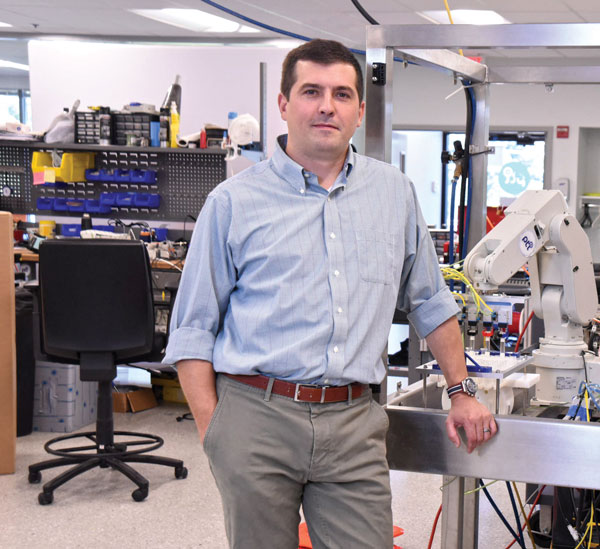
Oliver Stauffer, CEO of Packaging Technologies and Inspection (PTI).
PTI, a leader in package quality testing for the life sciences, usually sees a predictable end-of-year surge in orders, Stauffer said. However, that momentum failed to materialize as 2026 began.
“We were looking for some level of relief or an opportunity, but now it looks like demand is just not coming back to where it needs to be,” Stauffer added.
This reflects a broader global trend in the Life Sciences sector. After the hyper-investment of the early 2020s, the biotech and pharmaceutical industries are facing a “valuation correction.” With higher interest rates increasing the cost of capital, global firms are taking fewer risks on new product lines, leading to a direct slowdown in the demand for the high-precision testing equipment that PTI provides.
THE DEATH OF THE “OFF-THE-SHELF” MACHINE
While volume demand may be fluctuating, its nature has fundamentally changed. We are witnessing the end of the “Commodity Age” of machinery.
In increasingly competitive global market, customers are no longer looking for standard solutions; they are looking for a competitive edge through customization.
At MPI Inc. in Poughkeepsie, President Aaron Phipps has seen his business model evolve in real-time. MPI, which produces sophisticated wax-room equipment for investment casting, finds that customers are still investing, but they are demanding machines that are made for specific, often proprietary, processes.
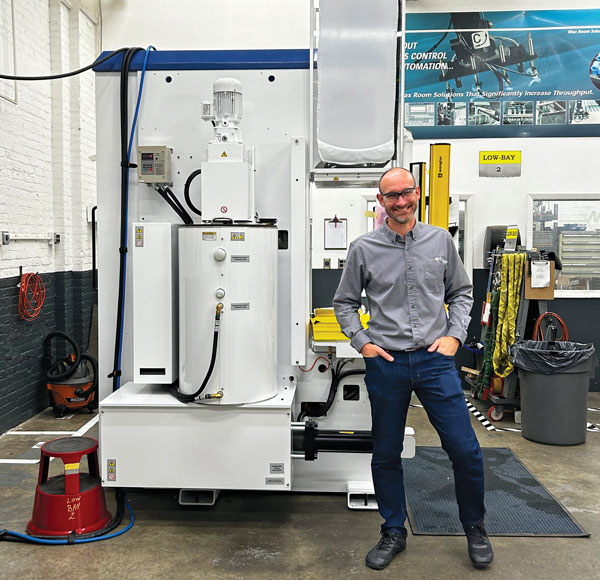
Aaron Phipps, President at MPI Inc.
Customization isn’t just a design preference; it’s a financial and logistical burden. Custom projects are often 50 to 100 percent more expensive and significantly extend lead times, Phipps noted.
For the equipment manufacturer, every custom order is a “first-of-its-kind” project, he continued, introducing risks in engineering and component sourcing that don’t exist with standardized products.
This sentiment is echoed in Milton at Sono-Tek Corporation. President Steve Harshbarger has leveraged the company’s ability to pivot between clean energy, semiconductors, and medical sectors to keep the wheels turning.

Steve Harshbarger, President Sono-Tek Corporation
“As long as you price it accordingly, customization can be a benefit and your margins can be really nice,” Harshbarger said. “But it does pull a lot of resources and unplanned scheduling delays to meet these big custom orders that manufacturers in the U.S. are now seeing.”
This shift toward customization is happening globally, as well as in the Hudson Valley. As low-cost manufacturing becomes more automated, U.S. companies are maintaining their lead by becoming “Consultative Manufacturers,” solving complex engineering problems rather than just selling hardware.
RESHORING VS. THE TARIFF BARRIER
One of the most significant narratives of 2026 is the “Return to the States.” After decades of offshoring, the fragility of global logistics has pushed companies to bring production closer to the end consumer.
Deborah Smook, co-founder of Turbofil Packaging Machines in Mount Vernon, sees this movement as a primary engine for her company’s success. For a specialized firm with just over 20 employees, the demand for local packaging solutions is a bellwether for the health of the U.S. supply chain.

Debra Smook and Eli Uriel, owners of TurboFil Packaging Machines in Mount Vernon.
“People want to keep and bring production here to the U.S.,” Smook said. “So, our local customers are building new capabilities and new lines.”
The Friction of Trade Policy
However, this domestic growth is facing a significant headwind of geopolitical protectionism.
The tariffs that remain in place have created a paradox for Hudson Valley manufacturers. While they protect domestic markets, they also increase the cost of the raw materials – heavy metals, advanced ceramics, and specialized electronics – that the U.S. is not currently equipped to produce at scale.
Sono-Tek’s Harshbarger points out that this uncertainty causes a “freeze” in the sales cycle.
Customers are increasingly sitting on products, asking manufacturers to delay shipping in hopes that a change in tariff policy might save them thousands of dollars in import/export duties. This makes inventory management a nightmare for local firms who find their warehouses filled with complete machines that they cannot yet invoice.
THE “WAR OF THE STATES” AND REGIONAL COMPETITION
While geopolitics is a factor, local geography is presenting its own set of challenges. Neil McGill, Vice President of Allendale Machinery, highlights a growing domestic tension: The high cost of doing business in New York.

Neil McGill, Vice President of Allendale Machinery
Hudson Valley manufacturers are finding themselves in a battle of location, as the cost of living and energy prices in the Northeast continue to climb. McGill has observed a steady migration of work, and sometimes entire facilities, to Southern and Mid-Western states.
“We’re losing work down to the Carolinas and Midwest,” McGill warned. “We’ve also seen some of the bigger guy’s close shops and move down south…they slowly closed out upstate or in Long Island.”
To survive in New York, manufacturers must be more efficient, automated, and specialized than their southern counterparts.
The “New York Advantage” is no longer about cost; it is about the density of talent and the proximity to high-tech hubs, like the semiconductor corridor and the growing defense clusters.
As low-cost manufacturing becomes more automated, U.S. companies are maintaining their lead by becoming “Consultative Manufacturers,” solving complex engineering problems rather than just selling hardware.
THE TALENT GAP:
AI, AUTOMATION, AND THE HUMAN ELEMENT
Across every roundtable participant, one challenge remained the undisputed top-of-mind issue: Workforce.
We are amid a massive demographic shift. Our aging workforce means the retirement of the some of our most experienced machinists and engineers. In 2026, finding the right hire has become a technological battle.
Aaron Phipps at MPI noted that the hiring process is now cluttered with AI-generated resumes, making it nearly impossible to discern true experience from digital misdirection.
Automation as a Workforce Strategy
For many, the answer to the labor shortage isn’t hiring, it’s more robots. Turbofil has embraced this “Automation First” philosophy.
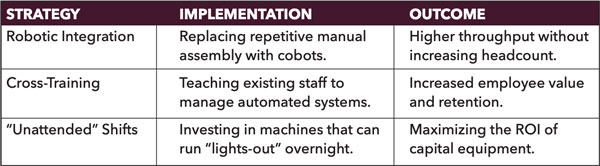
“If we can bring in a machine that will do something faster, or better, then right now we’re just going for it,” Smook said.
This represents a global shift in the “Human-Machine” relationship: We are no longer using machines to replace people, but to liberate people from the tasks that no one wants to do.
ENVISIONING THE 2027 HORIZON:
WHY OPTIMISM PREVAILS
Despite the tariffs, the labor shortages, and the geographic competition, the leaders of the Hudson Valley remain “overly optimistic.” This is because they are standing at the intersection of the world’s most exciting technologies.
- As the U.S. continues to subsidize domestic chip manufacturing & expand its defense capabilities, the Hudson Valley is perfectly positioned to serve as the “High-Precision Machine Shop” for these industries.
- The “Invisible” Innovation: Steve Harshbarger believes that the U.S. is currently in the middle of a massive high-tech boom that simply isn’t being reported by mainstream media. “If any of it comes to fruition, it’ll be pretty exciting to see what the capabilities are,” he says.
- Purpose-Driven Work: For leaders like Deborah Smook and Aaron Phipps, the satisfaction comes from seeing their machines solve real-world problems. Whether it’s a packaging machine that delivers life-saving medicine or a wax-injection system that creates aerospace components, the work being done in the Hudson Valley has a tangible, global impact.
THE HUDSON VALLEY INDUSTRIAL DNA
People enter manufacturing because they enjoy the unconventional, Neil McGill said. In a world of digital abstractions and gig economy uncertainty, the capital equipment sector offers something rare: the ability to point at a massive, complex, perfectly functioning machine and say, “we built that.”
The Spring 2026 outlook for the Hudson Valley is not one of easy growth, but of resilient evolution.
The Spring 2026 outlook for the Hudson Valley is not one of easy growth, but of resilient evolution.
By leaning into customization, embracing the “Automation Leap,” and navigating the complexities of a reshored global economy, these five companies are proving that the “Made in New York” label is still one of the most prestigious, and necessary, marks in the global market.