from life safety to manufacturing leadership
Guiding PECO Into Its Next Chapter
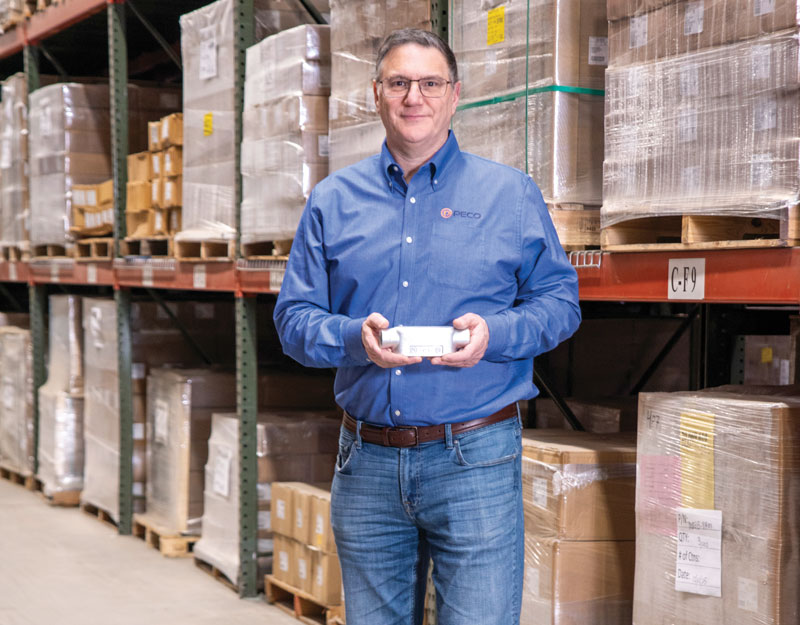
For nearly 90 years, Producto Electric Corporation (PECO), has supplied electrical conduit fittings and manufactured specialty cable support systems for some of the country’s most demanding environments.
Unlike many manufacturing leaders, PECO’s President Scott Aronson did not grow up in the family business. Instead, he came to manufacturing with the perspective of those who depend on safe and reliable infrastructure every day.
Before joining PECO, Aronson co-owned a consulting firm that provided fire protection, life safety, and emergency management services exclusively to healthcare facilities. The firm was later acquired by the international engineering company Jensen Hughes, where he remained a senior executive for 4 years before transitioning to PECO.
Much of his previous work focused on protecting patients and staff in complex care environments. That commitment continues today through pediatric disaster preparedness efforts and philanthropic initiatives supporting the people and communities those healthcare facilities ultimately serve.
HV MFG recently spoke with Aronson about his journey to PECO, the challenges of growing and modernizing a 90-year-old business, and the leadership principles guiding the company into its next chapter.
HV MFG: For readers who may not be familiar with PECO, how do you describe the company and the work you do?
SA: At our core, we’re a supplier and manufacturer of electrical conduit fittings and accessories, the components electricians use to connect, secure, and organize the conduit that houses electrical wiring, so everything remains safe and code compliant.
But what really defines us are our specialty product lines. We manufacture cable supports used in vertical risers for high-rise buildings, and hazardous location products, specifically explosion-proof flexible couplings that go into high-risk environments like paper plants, oil and gas facilities, and anywhere sparks could create a serious problem.
HV MFG: So, your products are really part of the infrastructure behind the scenes.
SA: Exactly. Most people never see them, but they’re critical in making sure electrical systems are safe and reliable.
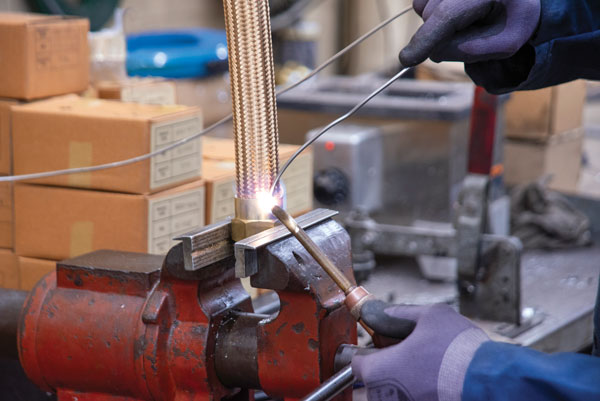
Finishing touches being applied to an Explosion-proof Flexible Coupling for hazardous locations.
HV MFG: Where would people encounter PECO products in the real world?
SA: Our cable supports are in almost every high-rise building. For example, we were the exclusive cable support supplier for JPMorgan Chase’s new headquarters at 270 Park Avenue in NYC, and we supported major projects like the Freedom Tower. You’ll also see our explosion-proof flexible couplings in paper or chemical plants, oil and gas facilities, gas stations, really anywhere that would be considered a true hazardous location under the National Electric Code (NEC).
HV MFG: Cable supports and explosion-proof flexible couplings are a specialized product. Can you talk a little more about that part of the business?
SA: Yes, we manufacture both products here in Orangeburg. We are 1 of 2 companies in the U.S. for the cable supports and we are one of only a handful of companies that manufacture explosion-proof flexible couplings for hazardous locations. These are both narrower markets than commodity fittings and where performance and reliability matter far more than price alone.
HV MFG: Why are those specialty products so critical in those environments?
SA: For cable supports, you are often dealing with high rises with substantial wiring going throughout the building. If you cannot hold the wires in place, they could pull free and potentially create a fire along with system failures.
For the flexible couplings, in some environments, there’s a higher threat that a spark could cause a fire.
If there’s humidity, water exposure, dust, or flammable materials involved, and you’re running electrical systems through those areas, you need protection that prevents ignition risk. It’s not optional. There are absolute requirements for using hazardous location products because of the risk if something fails.
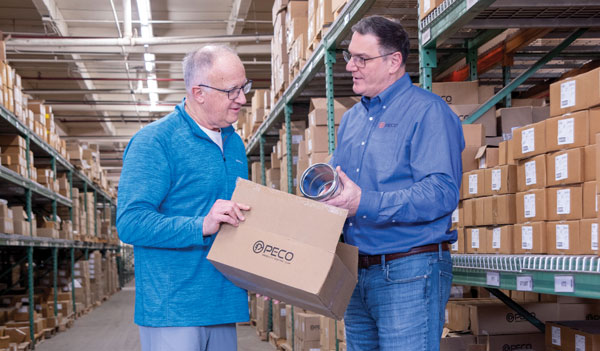
Patrick Romano, VP of Sales, and Scott Aronson, President, reviewing inventory and packaging.
HV MFG: We understand that before joining PECO, you built a career in life safety and emergency management. Tell us a little about that background and what drew you into that field.
SA: In college I considered a few different paths, including law or law enforcement. I did an internship with the police department, had the chance to do a few ride-alongs with the FBI field office, and spent some time in courtrooms. I realized pretty quickly I was looking for something in the middle, not in the trenches but not in a courtroom either.
I studied management with a concentration in Homeland Security and went on to co-own and lead a consulting firm focused on healthcare safety, fire protection, and emergency management. Our team worked primarily with hospitals and healthcare systems across the United States and Canada, helping them meet strict life safety codes and prepare for disasters and other emergencies. It was rewarding to know that the code consulting, training, and disaster exercises helped prepare healthcare facilities to protect their patients and staff in emergency situations.
After more than 15 years building the company, we merged it into a larger international engineering firm, where I remained on as a senior executive until early 2021.
HV MFG: How did that experience influence the way you approach this role today?
SA: A big part of that work was reviewing building plans for hospitals and healthcare facilities, making sure they met strict life safety codes to reduce fire risk and protect patients and staff.
When you do that work, you’re constantly asking, “What’s the failure point? What’s the consequence?”
HV MFG: So that mindset carried over when you stepped into your role at PECO?
SA: Absolutely. When I look at something like an explosion-proof flexible coupling, I don’t just see a product. I see the environment it’s going into. I understand the concept of why the code requires it, and I understand what’s at stake if it’s not a highly reliable product.
HV MFG: Walk us through the company history and how PECO ended up here in Rockland County?
SA: It was started by my great-grandparents in the Bronx. Back then they called it “the shop,” and my mom, who is also one of the PECO owners, even worked there in the late 1950s. There was a significant fire in the basement in the mid-1970s, and after that the business relocated here.
My great uncle, Art LeMay, ran the company until he passed at 91. He started as a shipping clerk and later enlisted in the U.S. Army, serving from 1944 to 1946 as a Browning Automatic Rifleman in the Pacific theater. After returning home, he spent the next 70 years leading and growing the business.
At the end of the day, we stay focused on what we can control:
supporting our team, building relationships, and delivering reliable products.
HV MFG: He sounds like an interesting man, tell us a little more about Art and your experience with him and PECO before officially coming on board.
SA: My uncle was known for building strong personal relationships with our suppliers and customers, and we are still benefiting from his efforts. He was also incredibly determined. After feeling like he missed something by not completing his college education, he decided to go back to school and graduated from Columbia University at age 67. Funny thing, he was jokingly upset because there was a 72-year-old woman in his class so he could not claim to be the oldest one there.
He was also an avid runner, completing 24 New York City Marathons and running them into his late seventies. I had the honor of running the final 13.1 miles of his last marathon with him. While he may not have had as much pep in his step at that time, he was almost at a full sprint up the final hill in Central Park. So amazing to see his excitement and desire to finish strong.
When I was younger, I used to visit the Orangeburg location, and I still have fond memories of him treating me like a special guest. He would even put “Welcome Scott Aronson” up on the sign in the lobby. As I got older, we would run the Manchester Road Race together and casually talk business. That is when I started to see the connection between the work I was doing in disaster preparedness and what he was doing in manufacturing and supplying major construction products.
After he passed, I came down to help work through the estate and support the team through the transition. What started as helping stabilize things quickly became an opportunity to step back, listen to the team, and understand where the business needed support. I saw PECO as a gem that hadn’t been invested in for more than 20 years.
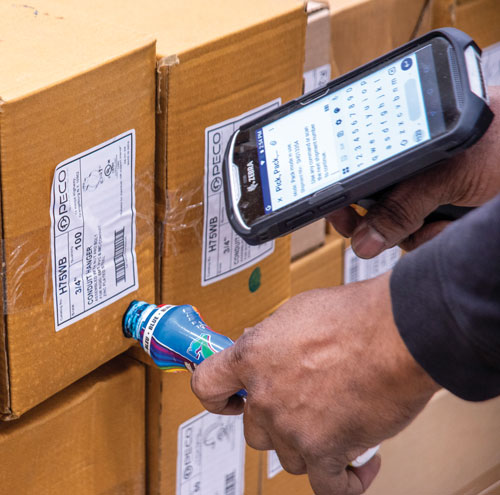
PECO’s handheld scanning and verification process accelerates order picking and real-time inventory updates.
HV MFG: What leadership lessons did you take from building your own company that you then applied at PECO?
SA: One of the biggest lessons is to listen first. When you build a company, you learn quickly that the people closest to the work usually have a clear view of what’s working and what isn’t.
When I came into PECO, many of the people who worked with my uncle were still here, and there was tremendous institutional knowledge. My first priority was to understand where the real pain points were and where the team needed support.
From my background in running my previous business and with several acquisitions I was involved with, I was used to stepping into complex situations, assessing what’s actually happening, and then bringing in the right expertise where it’s needed. Sometimes that means investing internally, and sometimes it means working with outside partners rather than trying to build everything yourself. At that time, RBT was that partner for PECO as they stepped in to run our finance/accounting, but also to provide leadership support while we prepared to navigate the next steps.
HV MFG: What were some of the changes you decided to make once things stabilized?
SA: First was our leadership team. We had a wonderful team at PECO, yet several of the team members were staying on to honor my uncle and holding off on their retirement. I can’t thank them enough for making sure we were ok before transitioning out.
We worked to bring two industry insiders to run our operations and sales with a focus on enhancing how we did business and preparing us for growth in the industry. They partnered up with our existing team to evolve PECO into what we are today. A special thanks to Ryan Vass and Patrick Romano for being these change agents and for Nancy Jaccoi in making sure the best practices of the past PECO were incorporated into everything we do today.
HV MFG: Where did you go next with infrastructure and operations?
SA: It started with infrastructure improvements and core systems, including a new ERP platform, and later we expanded our warehouse to help increase capacity and efficiency.
We also made a deliberate shift in mindset, focusing on responsiveness, growth, and the overall customer experience.
At the time, our average turnaround could be four to seven days. Today, same-day or next-day shipping is the norm and that alone has shifted how the market views us since some of our competitors, in our specialty product space, are quoting 20-plus weeks on products we can deliver in days or weeks. That’s meaningful.
HV MFG: That’s impressive, especially considering how difficult it can be for smaller suppliers to compete in this space. What growth opportunities are you seeing?
SA: Large data centers are a major driver of our growth right now. They are wire-intensive environments that demand robust infrastructure and advanced cabling solutions. That plays directly to our strengths.
We’ve also expanded our geographic reach, adding representation in Southern California and Nevada and strengthening our presence in markets like Florida, Georgia, Alabama, Indiana, Ohio, and Chicago. The opportunities are out there for more rapid growth, but we need to continue to focus on strategic growth.
We’re working with partners to expand our support for safe infrastructure in underserved regions in Peru.
HV MFG: This is a time of uncertainty for manufacturers. How is that impacting your planning?
SA: Uncertainty is never a good thing and right now trade policy is driving a lot of uncertainty for our business. When tariffs move from 10 percent to 25 percent to potentially 50 percent and then are challenged or overturned, removed then reinstated, it becomes exceedingly difficult to plan. The issue isn’t necessarily the policy itself; it’s the back and forth that leads to uncertainty. Nothing feels locked in and it makes it harder to compete than it should be.
Immigration policy is another uncertainty that is impacting many of our employees. Our workforce is everything. These are good jobs, union jobs, and our team members are hardworking individuals who have followed the process, but immigration policy uncertainty is causing disruption and anxiety. Earlier this year, we experienced a situation where a couple of employees’ Temporary Protective Status (TPS) was set to vanish, only to be saved by an eleventh-hour court stay. In some cases, we’re talking about people who have been with us for a decade or more. That kind of back and forth isn’t abstract. It creates real stress that understandably carries into their families and the workplace every day.
But at the end of the day, we try to stay focused on what we can control: supporting our team, building relationships, and delivering reliable products.
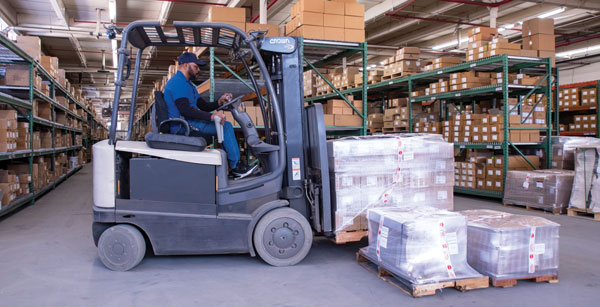
Ilrick Georges, Plant Supervisor, preparing a shipment for a project in New York City.
HV MFG: Beyond manufacturing, let’s talk about your community engagement and philanthropy initiatives. We understand you have recently been recognized by The Arc of Rockland and The Arc of New York for PECO’s work with people with intellectual and developmental disabilities. Why has this work remained important to you?
SA: The relationship between PECO and The Arc goes back decades. My great aunt resided in their group home program in Westchester County, and my uncle welcomed individuals supported by The Arc into the business to work on projects. The program paused for many years, and once everything stabilized, it made sense to reconnect. The Arc has had such deep meaning for my family for decades, but what I didn’t anticipate was the impact it would have on our team. It increased a shared sense of purpose, and our warehouse staff will tell you they even picked up the pace after watching how focused The Arc team members are.
And now they’re truly part of our team and they join us for pizza parties and other special activities like everyone else.
HV MFG: Tell me a little more about the project in Peru and the efforts to support safe infrastructure in underserved regions.
SA: I remain actively involved in disaster preparedness through my work with Global Readiness Partners, which specializes in training for Neonatal Intensive Care Units (NICU) and Pediatric Intensive Care Units (PICU). That work reinforces how important it is to safeguard the most vulnerable patients. When my family had the opportunity to visit a hospital under construction, the Vidawasi Pediatric Hospital in Peru’s Sacred Valley, it was clear that my background and our products could have an impact in a region that currently has limited access to pediatric care. After meeting with the developers and talking about proper infrastructure safety, it was an easy decision to donate products and volunteer as a fire and emergency management consultant. We’re working with partners to expand our support for safe infrastructure in underserved regions. Infrastructure matters. Safe buildings matter. Reliable systems protect people.
HV MFG: After everything we’ve talked about, your background in safety and emergency preparedness, modernizing a family business, and supporting your workforce, what do you try to get right as a leader every day?
SA: If we had more time, I could tell you about all the times I got it wrong. But, at the end of the day, I try to remove barriers and give people the tools they need to be successful.
If we stay accessible, accountable, and focused on protecting our people and our customers, everything else tends to follow.