

Punching Above Their Weight
Automation, AI and Modern Machining
A NEW GENERATION OF MANUFACTURERS
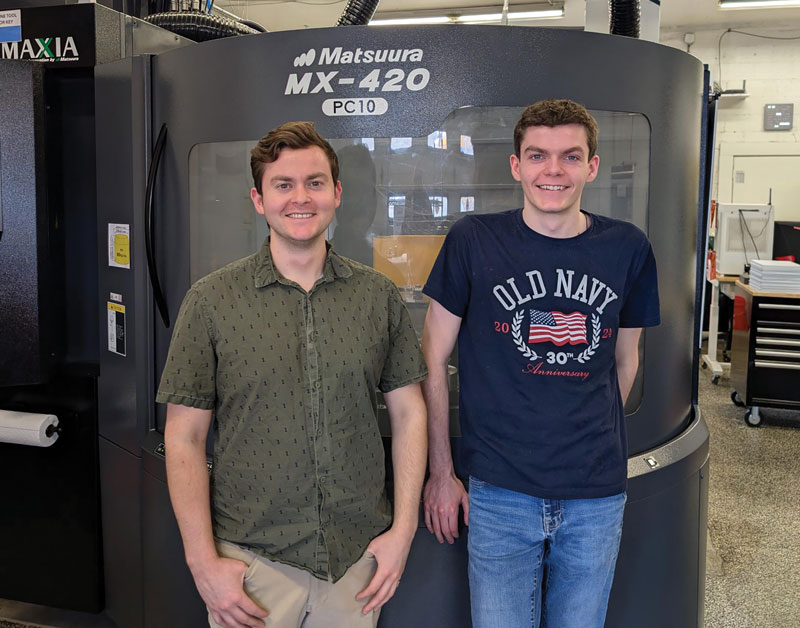
Brothers Sean (left) and James (right) Cerven founded Cerven Solutions out of their parents’ garage in 2020. The growing manufacturer of precision parts for the aerospace industry stays nimble by employing the latest and most advanced technologies.
In 2020, while manufacturers across the country navigated shutdowns and supply chain disruptions, two brothers in Dutchess County saw an opportunity.
James and Sean Cerven launched a small but ambitious CNC machining shop inside their parents’ one-car garage.
Cerven Solutions specializes in precision components requiring tight tolerances and complex geometry – serving aerospace, medical and emerging technology sectors – with prototype and low-volume production support.
 Much of their work involves intricate components, multi-axis machining and consistent documentation for customers developing new products or scaling early production runs.
When the brothers began the business, Sean was working full-time in manufacturing while finishing his MBA, and James was pursuing a degree in mechanical engineering.
Nights and weekends were spent experimenting with 3D printing and small-scale machining projects, an extension of their lifelong interest in building things in their father’s hobbyist workshop.
What began as a side project quickly accelerated. The brothers soon discovered that buying a CNC machine was only the beginning. Tooling, holders, materials and supporting equipment added up quickly.
But they also recognized something else: manufacturers were struggling to get parts delivered on time.
“We started investing in tooling and materials and realized, this is expensive,” James Cerven said. “Then we thought, if we make parts for other companies, the work can pay for the tooling. So, we started trying to get customers.”
It worked.
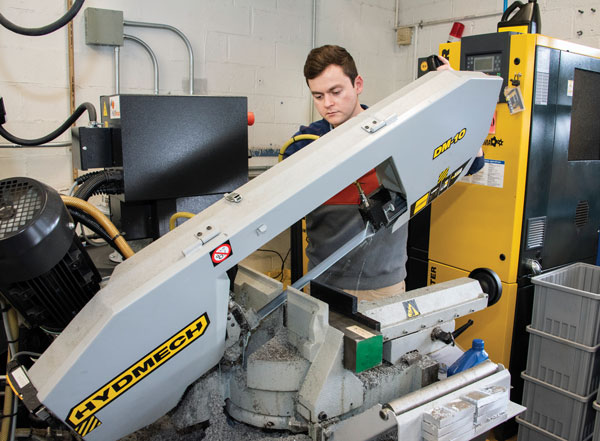
Co-Founder Sean Cerven cutting bar stock to the required dimensions before creating a customer’s part.
The now four-person manufacturing facility focuses on rapid prototyping and low-volume production of custom parts and plate work. Their Poughkeepsie-based shop is filled with equipment, a stark contrast to where it all started.
Real Applications
Cerven Solutions broke into manufacturing with a fresh perspective on how a modern machine shop can operate. Fascinated by innovation and emerging technology, the brother’s welcome new tools not as novelty or obligation, but as something that drives a competitive advantage.
“It’s exciting because we get to use new tech, and the machines we have are brand new, not older than us,” said Sean Cerven. “We’re trying to push the envelope as much as we possibly can because we know it makes us two to three times more efficient out of sheer necessity. It’s a clear competitive advantage.
“Since we haven’t been running the same product for 30 years, and we don’t have someone standing at a machine to keep it loaded, we can begin with the end in mind.”
That mindset guided their capital investments. The brothers purchased 3- and 5-axis machines, including a FANUC RoboDrill equipped with a tilt-rotary table, along with a robotic machine-tending system to maximize flexibility and scale repeat production.
In some cases, building a $300 custom tool can reduce cycle time on repeat parts to 1,000 pieces in four minutes with minimal oversight, allowing the shop to run lights-out production on repeat jobs. At that pace, the return on investment can come in a single night of running.
For a small shop, that kind of automation allows production to continue with minimal oversight, increasing output without dramatically increasing head count.
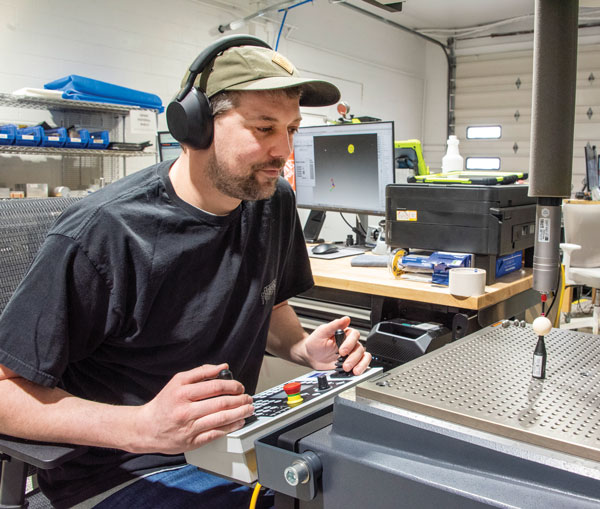
Quality Assurance Manager Shane Richardson reviews a part inspection report. Shane ensures that all parts manufactured by Cerven Solutions machine meet AS9100 standards and customer requirements.
Beyond automation on the shop floor, Cerven Solutions has embedded technology into its operations. The brothers built a customized internal application using AI-tools to track inventory, manage tooling levels, build orders and schedule production according to how their shop runs.
“It took a lot to get the app built so that it was secure for our type of work, but it’s all worked out now,” James Cerven said. “That’s been at the front of our mind while we grow this business. Not just technology for technology’s sake, but for real applications and ROI.”
As the shop grew, so did the need for structure. Cerven Solutions formalized their operations and strengthened inspection and quality oversight. Hiring two additional employees allowed them to improve documentation control, traceability and production discipline, and foundational elements for a shop taking on more complex work.
Playing Every Day
Starting a manufacturing business has been no small feat for the Cervens. While their youth brings energy and flexibility, it also means earning trust in an industry where many customer relationships span decades.
“Our customers appreciate that we’re not retiring in five years,” Sean Cerven said. “But when we first walk into a shop, sometimes they look at us and think, ‘no way.’ Later they tell us they thought we were their age too.”
To overcome that perception, the brothers let their work speak first. Initial prototype jobs often lead to repeat production runs, and consistent performance has helped turn new contacts into long-term partnerships.
Trade shows have played an important role in expanding their reach, allowing the brothers to meet manufacturers and buyers from across the country.
At the same time, they have focused on building connections closer to home. The Cervens have connected with other manufacturers, suppliers and potential customers across the Hudson Valley through regional manufacturing events and industry organizations, such as the Council of Industry.
They say those relationships have been invaluable. Experienced manufacturers in the region have offered advice and encouragement as the company has grown.
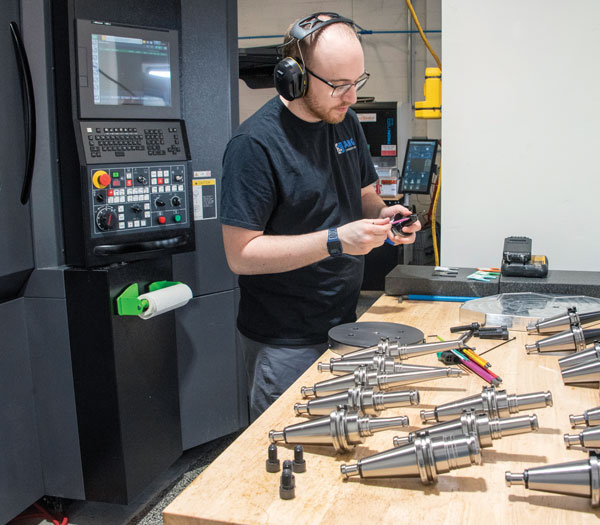
Machinist Jacob Kitchen tooling up the high precision, 5-axis machine for an aerospace job. Earlier he simulated the toolpaths with a CAM (Computer Aided Manufacturing) program to reduce as much as possible the risk of crashing or scrapping parts
Several industry leaders have taken an interest in their progress and supported their growth, including Sean Hamilton, Director of Operations at Putnam Precision in Brewster, and Aaron Phipps, President of MPI Systems in Poughkeepsie.
These connections have helped the brothers navigate everything from supplier relationships to customer introductions as the business has grown.
Winning work was only part of the challenge. Running a manufacturing business requires learning – pricing strategy, managing cash flow, scheduling production and maintaining quality systems, while continuing to invest in equipment and technology.
“This is the most work and the most stressful thing I’ve ever done,” James Cerven said. “But it feels like we’re playing every day.”
Their technical training helped provide a foundation for that learning curve. Sean graduated from SUNY New Paltz with a degree in Mechanical Engineering, while also earning his MBA when the brothers launched the company. James began pursuing a degree in Mechanical Engineering before shifting his focus to working full-time in the shop.
That combination of engineering and business training now shapes how the company operates. Sean, 29, focuses primarily on operations, systems and long-term planning, while his younger brother James, 23, leads customer acquisition and production.
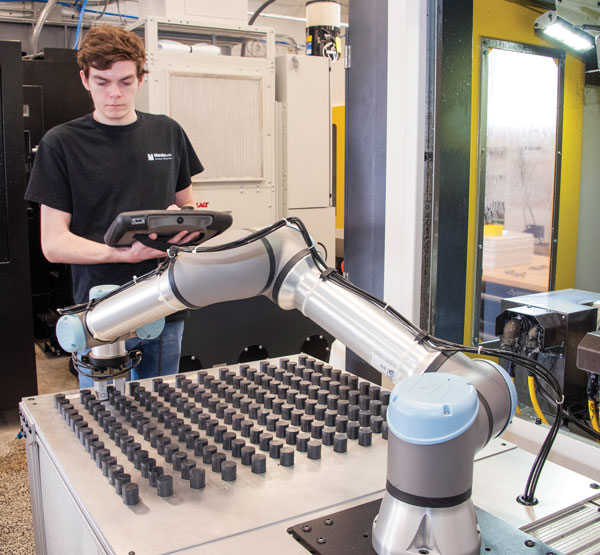
Co-Founder James Cerven setting up Robot, our ‘employee’ of the month, for its next job. The robot allows Cerven Solutions to run parts continuously day, night and over the weekend.
They also credit their outside perspective as an advantage. Without inherited shop habits or decades of legacy processes, they say they are more willing to question assumptions and redesign work flows when problems arise.
“When something comes up that might be common for a shop that’s been around for a while, they’ll just deal with it,” Sean Cerven said. “We’d rather figure out something different.”
Punching Above Our Weight Class
The next phase of growth for Cerven Solutions is already underway. The company is preparing to meet the rigorous quality and documentation standards required for components used in launch systems. That preparation has meant tightening documentation practices, strengthening traceability, and ensuring every step of the manufacturing process can be verified and repeated.
“When you’re making parts that could ultimately fly on a rocket, everything needs to be in order,” Sean Cerven said.
Meeting those standards has pushed the brothers to further formalize processes across the shop floor. The goal is not simply to enter another industry, but to continue raising the level of precision and accountability throughout their operations.
Cerven Solutions is also becoming more selective about the projects it takes on. The brothers are balancing prototype development with production work that fits their capabilities and long-term strategy as demand grows.
Yet they are not rushing to expand their footprint – The focus remains on maximizing the output of the space and systems they have built.
“We don’t need to have a massive shop to have a big impact,” James Cerven said. “Even at our size now, our output is easily that of a shop with double or triple the number of people. We can really punch above our weight class by staying disciplined about how we run the shop.

Ciara McEneany is the Member Services Coordinator for the Council of Industry.


